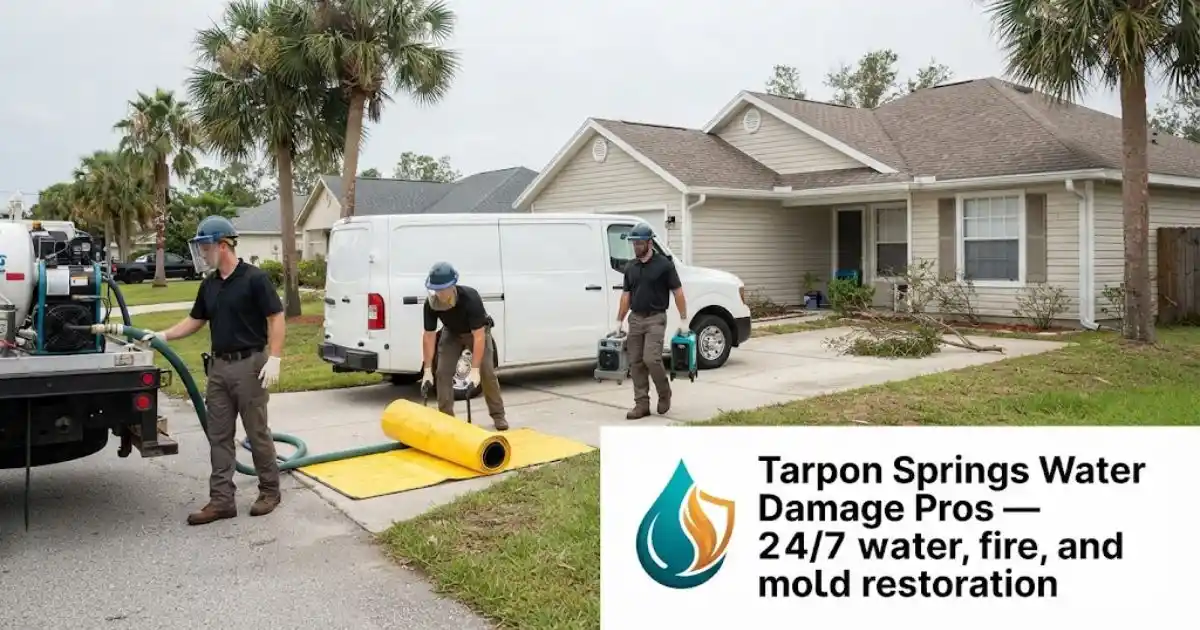
Emergency water, fire, and mold restoration for homes and businesses across Tarpon Springs — from the Sponge Docks and Anclote River waterfront to the bayou neighborhoods and inland streets near US 19. Documented assessment, direct insurance coordination, and a crew that answers the phone.
Our dispatch line is answered 24 hours a day, every day of the year, including storm season.
Tarpon Springs sits on the Pinellas peninsula along Florida's Gulf Coast, bordered on three sides by the Anclote River, the Gulf of Mexico, and Lake Tarpon. Nearly half the city's total area is water. That geography is part of what makes the Sponge Docks and the bayou neighborhoods so distinctive, and it's also why water damage here is rarely a one-off event.
In September 2024, Hurricane Helene pushed storm surge into low-lying parts of the city, with floodwater reaching Main Street in the historic district. Two weeks later, Hurricane Milton followed, and the Southwest Florida Water Management District had to actively draw down Lake Tarpon ahead of the storm to keep surge and outfall-canal flooding from overwhelming the lakefront neighborhoods. Both storms left real, physical water damage behind in homes that are still being repaired.
The city responded with a no-cost storm-related building permit program that ran through May 13, 2025, and, because recovery is still ongoing for a meaningful number of property owners, the substantial-damage compliance deadline has since been extended to June 1, 2026.
Tarpon Springs is also a named participant in Elevate Florida, the state's $400 million-plus home-hardening and mitigation program. None of this is distant history; it's an open, active recovery window right now, which is exactly why a fast, documented response matters if your property was affected or if you're dealing with damage that surfaced after the fact.
Tarpon Springs also has real hurricane pedigree going back further: the 1921 Tarpon Springs Hurricane, a Category 3 storm with an 11-foot surge, is still referenced today as the historical benchmark event for this stretch of the Gulf Coast, including in coverage comparing it to Milton. Add roughly 50 inches of annual rainfall and a humid subtropical climate, and it's clear why water intrusion, structural drying, and mold prevention are year-round concerns here, not just a hurricane-season issue.
A lot of the housing stock compounds the risk. Many homes along Spring Bayou, the Anclote River, and inside the Tarpon Springs Historic District. The 140-plus designated historic buildings along and near Tarpon Avenue. Predate current flood-elevation standards. Older construction, aging plumbing, and lower first-floor elevations mean that both storm surge and routine plumbing failures tend to do more damage, faster, than they would in newer construction elsewhere in Pinellas County.
Get a fast, documented assessment before more damage sets in.
We respond throughout Tarpon Springs, including the historic Greektown and Sponge Docks district along Dodecanese Boulevard and the Anclote River, the Spring Bayou "bayou country" waterfront streets south of the river, the Tarpon Springs Historic District around Tarpon Avenue, and the residential neighborhoods near Craig Park, Howard Park Beach, and the Fred Marquis Pinellas Trail. Waterfront and historic-district homes tend to face the most direct storm-surge and groundwater exposure, while inland properties near US 19 more often deal with wind-driven rain intrusion and roof-related leaks during storm season.
Two mold-related patterns come up constantly on our dispatch line here, and it's worth understanding the difference. The first is leak-triggered mold — growth that follows a specific event like a roof leak, a burst pipe, or storm-surge intrusion, and shows up within days of that event.
The second is condensation-driven mold, which has nothing to do with a single storm and everything to do with year-round humidity: it develops slowly in closets, behind furniture, and in low-airflow rooms simply because Tarpon Springs stays warm and humid for most of the year. Both need different treatment approaches, which is why we ask about the history of the space, not just what it looks like today, before scoping a job.
What We HandleCrews answer and mobilize any hour, including during active storms.
We document damage and communicate directly with your adjuster.
Experience with surge, bayou flooding, and older-home drying challenges.
A documented scope of work before any repair begins.
Describe the damage. Flooding, fire, or mold. Any hour of the day.
On-site inspection and a documented, written scope of work.
Extraction, drying, containment, or board-up begins right away.
Structural repair back toward pre-damage condition.
Varies by number of rooms affected and how long water sat before extraction.
Depends on affected square footage, containment needs, and root cause.
Scope varies significantly with structural and smoke-damage extent.
Ranges shown are typical starting points. Every job gets a written, itemized assessment before work begins.
We document damage with photos and moisture readings, provide a detailed scope-of-work report, and communicate directly with most major carriers. Useful for both storm-related claims and everyday plumbing failures.
Yes. Water damage and mold remediation are closely related in this climate, and a large share of our calls ask for both — we assess for hidden moisture and early mold growth as part of every water damage inspection, and can scope both under one visit.
Tarpon Springs extended its substantial-damage compliance deadline for storm-affected properties to June 1, 2026, so many homeowners are still inside that window. We document damage in a way that supports permitting and compliance conversations with the city.
Our dispatch line is answered 24/7, and average arrival for active water damage is around 60 minutes, sooner when conditions allow.
Coverage depends on your policy and the cause of loss. We document findings thoroughly and coordinate directly with most major carriers to support your claim.
Call now. A crew can be dispatched to Tarpon Springs today.
☎ Call (727) 591-9483